


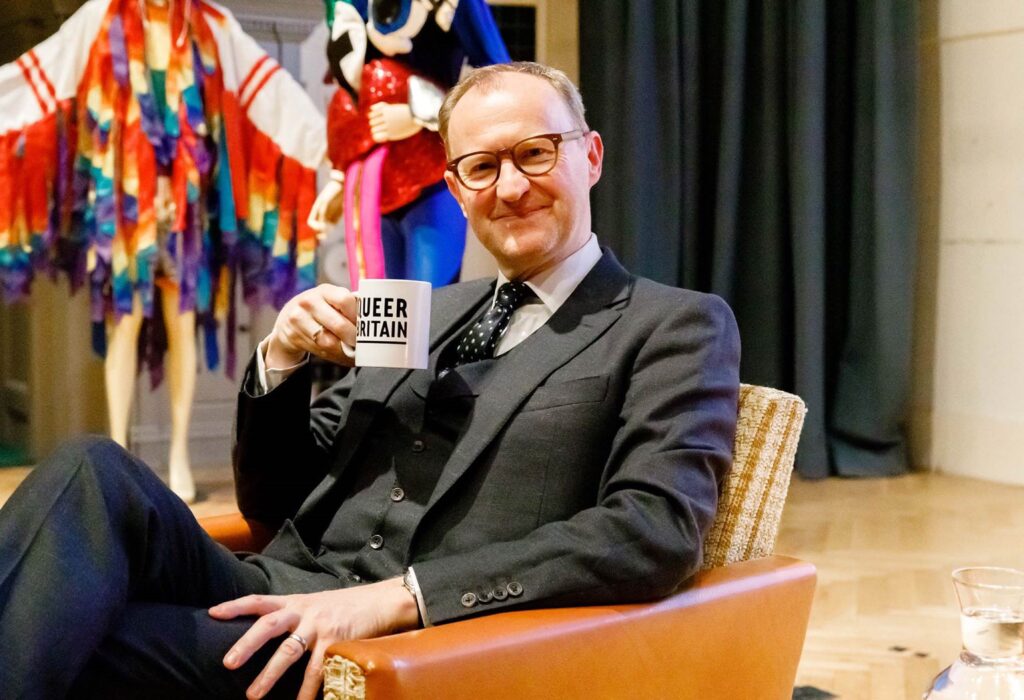
To celebrate LGBT + History Month, the Thomson Reuters Foundation partnered with Queer Britain, a charity working to establish the UK’s first national LGBTQ+ museum. The event hosted by Queer Britain on February 6th offered a rare glimpse into Britain’s queer past through the eyes of Mr Lucas, a British civil servant working in London in the 1950s and 60s. At the event, excerpts from Mr Lucas’s diaries were read by actor and director Mark Gatiss to a captivated audience.
Mr Lucas was a gay man in a society where homophobia and discrimination were widespread, and where it was illegal for gay men to engage in sexual activity until 1967. Living through these tumultuous times, Mr Lucas documented his experiences in a series of detailed personal diaries, capturing a rare insight to this period of history for LGBT+ people. When he passed away, he bequeathed the diaries to journalist and LGBT+ activist Hugo Greenhalgh.
Hugo, Editor of the Thomson Reuters Foundation’s LGBT+ news platform Openly, started to examine the extraordinary collection that stretches from 1948 to 2014 and uncovered remarkable accounts of a man who recorded his love life, homophobic attacks, and other aspects of gay life and culture at the time. “He’s such a good writer, all the details are brought incredibly to life. You absolutely are there. You hear not just what life is like inside the pub, you hear this wonderfully boring account of his life as a civil servant at the Board of Trade. But you also hear what’s happening in the background: the news and the politics of the time. They are incredible social records; newspaper clippings and photographs and millions and millions of words” said Hugo.
Following the reading, Hugo joined Mark for a discussion about the diaries and their place in LGBT+ history in the UK. Hugo met Mr Lucas while researching a documentary on male prostitution in the 20th century. Although Mr Lucas eventually declined to take part in the documentary, he became a friend of Hugo’s and left him his treasured diaries when he passed away. Unsure what to do with the diaries, Hugo started posting extracts in 2017 on Facebook. Hugo hopes to turn the diaries into a book at some stage.
“For an unremarkable man, he led a rather remarkable life. When Mr Lucas – never George – died, he left me his diaries. Oh god, his diaries. Millions upon millions of words. Everything detailed: his moods, movements and the staggering details of the life of a gay man in the 1960s-80s in London. It’s a fascinating historical record; a guide to the gay scene, or what there was of it; a guide to the homosexual underworld,” said Hugo.
“Mr Lucas’s diaries are a treasure-trove of insight into the minutiae of daily life from an ostensibly conservative gay man who’s also an enthusiastic (and sometimes anguished) member of a sexual underground. His life straddles huge changes for his community and he presents an unvarnished record that shifts between the mundane, cultural and political. It is precious to have a pre-criminalisation first-person voice recorded in such detail. This is why we are proud that they will eventually find a home in the Queer Britain collection. Openly and Hugo Greenhalgh’s workplaces LGBTQ+ people and their voices front and centre, where they belong. Given their journalistic integrity, partnering with them on this event really was a no brainer” said Joseph Galliano CEO and Co-Founder of Queer Britain.
Share


Sign up to our newsletter
More News
View All
World News Day: every $1 invested in journalism can return $100 to society. So why are we letting it collapse?
Defending journalism is not just a moral responsibility. It’s an economic and democratic…
Read More
AI legislation is important in upholding universal human rights
Our Director of Responsible Business,…
Read More
How civil society can counter the rise of legal restrictions across Latin America
New…
Read More
Legal support: a lifeline for civil society and democracy
How democracies become stronger when civil society…
Read More
How upholding workers’ rights builds democratic resilience
How businesses treat their workers…
Read More
Protecting independent media is protecting democracy
How protecting independent media protects democracy itself.
Read More
What legal risks do content creators face? 5 key considerations for influencers
Content…
Read More
What the EU’s Procurement shift could mean for workforce disclosure
In the wake of the…
Read More
Why existing support for civil society can’t solve this crisis
Most support wasn’t designed…
Read More
What happens when content creators and journalists come together?
Our Multimedia Editor for Openly,…
Read More

