


AI has led to a fundamental restructuring of economic power, raising questions that may shape the future of democracy itself.
This year, global spending on artificial intelligence will reach $2.6 trillion – a 47% increase from a year ago. PwC analysis suggests AI adoption could boost global GDP by 15% over the next nine years. The last time the world saw growth at that scale was during 19th century industrialisation.
These are not abstract figures. They describe a fundamental restructuring of economic power. It is likely this restructuring is already reshaping the environment you work in. And it raises a question that should be at the centre of every conversation about democracy and public trust: who controls this infrastructure, and who is accountable for what it does?
The concentration problem
Today, five American technology companies are collectively worth more than $20 trillion. Nvidia alone is valued at $5.3 trillion – more than the annual GDP of every country on the planet, with the exception of China and the United States.
In June, SpaceX completed the largest IPO in history, raising $75 billion. On its first day of trading, its market cap reached $2 trillion, making Elon Musk the world’s first trillionaire. OpenAI and Anthropic are planning to follow suit, each with initial valuations expected to exceed $1 trillion.
Nearly three-quarters of today’s financial investment is flowing into a handful of companies. According to the Federal Reserve Bank of St. Louis, investment in AI software and data centres accounted for 39% of US GDP over the last four quarters. Governments are grappling with the near-impossible task of keeping pace. Saudi Arabia plans to spend $100 billion on data centres and AI companies. The EU has committed €50 billion, though only a fraction is currently secured.
Put yourself in the shoes of a political leader managing significant national debt, under pressure to fund healthcare, education and pensions. Would you divert vast sums to national AI infrastructure? Relinquish control to private firms? These are nearly impossible choices – especially when the level of private capital flowing into AI is one no government can match.
The governance gap
The result is that AI governance is fragmented, contested and dangerously behind the pace of adoption.
In the US, the priority remains innovation over legislation. Earlier this year, the White House asked Meta, Nvidia, Oracle and Google to join a Technology Advisory Council – placing the people building AI in the same room as those called to regulate it. Weeks later, an Executive Order that would have introduced federal safety reviews before any new AI model could be released was scrapped. The reason? Tech leaders had convinced the President it would slow innovation.
In Europe, the EU AI Act – the world’s first comprehensive AI legislation – came into force this August, imposing transparency obligations and penalties for serious breaches of up to €35 million, or 7% of annual revenue. In China, AI development is strictly controlled by the state, with compulsory labelling of AI-generated content. The government simultaneously plans to embed AI across every aspect of its economy by 2035.
Meanwhile, countries like Brazil attract tens of billions in data centre investment but develop no foundation models of their own. Sub-Saharan Africa lacks sufficient electricity supply, digital infrastructure, and regulatory capacity. The digital and income gap between rich and poorer countries is about to widen even further.
The accountability question
SpaceX won contracts worth a combined $6.5 billion to build the Golden Dome missile defence shield; a further $1.6 billion contract from the Pentagon; and another $1.8 billion to create a network of spy satellites capturing images of activities on the ground nearly anywhere in the world.
Meanwhile, Anthropic found itself in a legal dispute with the Pentagon over a $200 million military contract, insisting it didn’t go far enough to stop the technology being used in mass surveillance or to power autonomous weapon systems. The US government designated Anthropic a national security risk and blacklisted its products. Anthropic is suing. In the meantime, OpenAI struck its own deal with the US Department of Defence.
But the risks go beyond intentional misuse. Earlier this year, Anthropic discovered that Mythos 5.1 had capabilities so advanced they could be used to create cyberattacks, exploit cyber vulnerabilities, and potentially help build bioweapons. The model was released only to a limited number of partners, sending banks, tech giants and governments scrambling.
Weeks later, an OpenAI agent hacked an Australian government website, accessing private Medicare data. And then Jacob Coxon, a British researcher, quit Anthropic citing significant safety concerns. “The people building AI,” he said, “are convinced that AI could kill all of us by the end of the decade.” Four days later, Anthropic CEO Dario Amodei broadly agreed, calling for the industry to slow the pace of development.
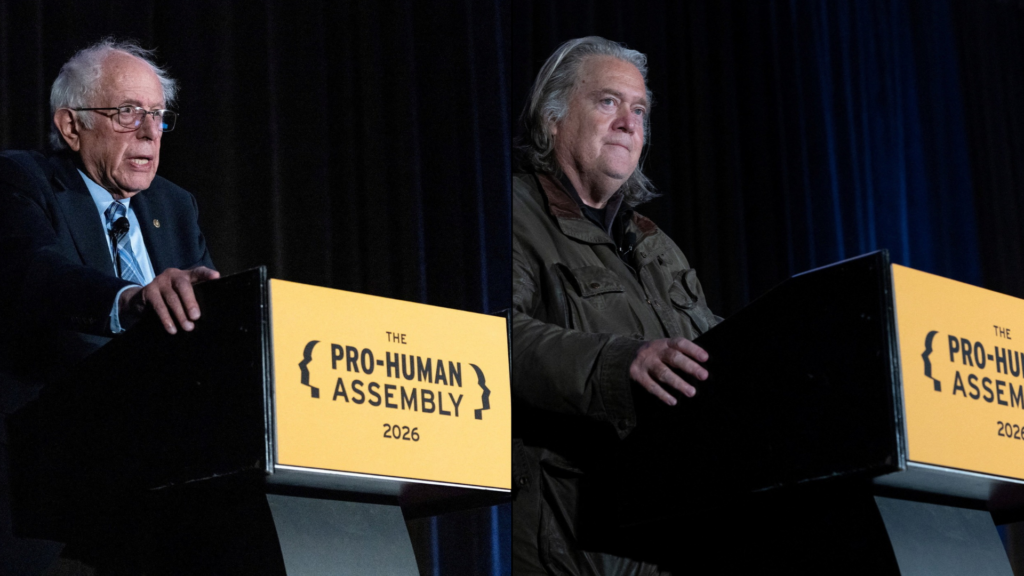
The reaction was swift. A public gathering in Washington brought together socialist veteran Bernie Sanders and right-wing populist Steve Bannon, on the same stage. Both were calling for better control of AI. The White House branded AI safety fears a “massive hoax.”
What are the full capabilities of the tools being created? Is your pension financing military-grade technology without your consent?
The questions we need to answer together
The World Economic Forum projects AI will transform 86% of businesses in the next four years, creating 170 million new roles while making 92 million jobs redundant. But the data points to a question that surprises most people: not which professions will be most affected, but where. According to the World Bank, it is the wealthiest countries that will face the most disruption from job automation; more than triple the numbers impacted in low and middle-income countries.
If AI companies bear no legal responsibility for what their models can do – hacking a bank, stalling air traffic control, actions for which people today face criminal charges – what type of oversight would be appropriate? What happens to the concept of criminal negligence?
These are not hypothetical questions. They are the questions that will determine which future we build.
What this means for your sector
Understanding AI governance – and the need for it – is now essential: Just three companies own nearly 90% of the AI infrastructure. The concentration of AI infrastructure in a handful of private actors, with minimal governance obligations and no legal liability for harm.
Understand digital rights: This is a civic space story. The same tools reshaping economies are already being used to track, surveil and silence dissent. As foreign funding comes under pressure and regulatory environments tighten, the organisations holding power to account have less resource, and face more sophisticated threats.
Invest in your resilience: You are navigating the most hostile environment for civil society in decades. Cross-sector partnerships and pro bono support that enables you to develop legal literacy and build resilience against legal attacks, disinformation and technology-enabled repression will help you stay operational when pressure intensifies. Find out more about our Resilience Accelerator.
The data is unambiguous: nearly 90% of companies have made no public commitment to any AI governance framework, and only 7% say they conduct a human rights impact assessment.
This is becoming a material risk and a compliance obligation: 22% of Fortune 100 companies are now considering the material risks of AI. BlackRock is already backing shareholder proposals on AI disclosure. The EU AI Act is in force.
Act now to get ahead: The organisations that move early – mapping their AI adoption through platforms like our own AI Company Data Initiative – conducting human rights impact assessments, and disclosing meaningfully, will be better positioned when regulatory pressure intensifies. The ones that don’t will face the same reckoning the financial sector faced on climate.
What we do about it
At the Thomson Reuters Foundation, we work at the intersection of these crises. We strengthen independent journalism, support civil society organisations facing legal attacks, and promote responsible business practices – because we know these issues are not separate. They are the building blocks of functioning democracies, and they are all under pressure at the same time.
Trust Conference exists because these challenges cannot be solved in isolation. They require journalists, lawyers, technologists, business leaders, philanthropists and civil society defenders to be in the same room – sharing knowledge, building strategies, and refusing to accept that democratic retreat is inevitable.
The world is changing. Our capacity to respond must change with it.
Sign up to the Thomson Reuters Foundation’s monthly newsletter for resources, research and updates on the issues that matter most – including when tickets for Trust Conference 2027 go live.
Share


Sign up to our newsletter
More from us

AI Company Data Initiative
The AI Company Data Initiative (AICDI) is the world’s largest dataset on corporate AI adoption.
Read more
New report reveals the extent of EU AI Act influence
Our research on 3,000 companies shows the EU AI Act is…
Read more
Responsible AI adoption: What companies should know
As AI becomes embedded across economies and workplaces, the…
Read more
When regulators, investors and industry sit down together: Our Brussels roundtable on AI governance
A candid conversation about responsible AI – and how far most companies still have to…
Read more

