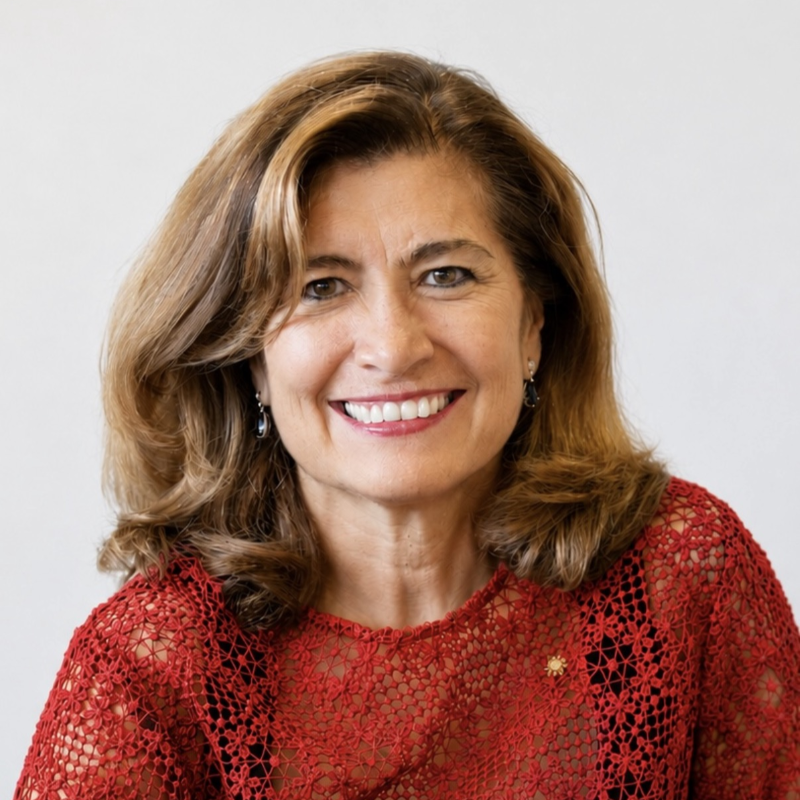
Gabriela Ramos
Gabriela Ramos is an international executive who has led global institutions and helped shape international agreements on artificial intelligence, climate change and gender equality. She chairs the Board of the Center for AI and Digital Policy, is an Affiliate Professor of Tech and Global Affairs at the Paris School of International Affairs at Sciences Po and serves as a Senior Fellow at the Institute for AI Policy and Strategy.
At UNESCO and the OECD, Ramos championed inclusive growth and people-centred development. As UNESCO Assistant Director-General for Social and Human Sciences, she spearheaded the adoption of the landmark Recommendation on the Ethics of Artificial Intelligence by 194 countries. She led the rollout of AI Readiness Assessments in more than 80 countries, helping governments align their AI policies with human rights and democratic values. She also led the adoption of a global standard on the ethics of neurotechnology, strengthening UNESCO’s role in the governance of emerging technologies.
Earlier, as OECD Chief of Staff and G20 and G7 Sherpa, Ramos helped negotiate international responses to the global financial crisis and the COVID-19 pandemic, as well as agreements on tax transparency, climate commitments and AI. She founded and steered the OECD’s New Approaches to Economic Challenges initiative, which examined the limits of conventional economic thinking and explored new approaches to policymaking. Since 2024, she has co-chaired the Taskforce on Inequality and Social-related Financial Disclosures (TISFD), an international effort to help companies and investors assess and disclose how their activities affect people and contribute to inequality.
A Fulbright Scholar and graduate of the Harvard Kennedy School, Ramos received the Forbes Excellence Award and was named among Apolitical’s 100 most influential people in gender policy and Knowledge Networks’ 100 leading voices in AI policy in 2026. She was decorated with France’s National Order of Merit and received an honorary doctorate in humanities from the University of Wales Trinity Saint David in July 2026.
Ramos serves on Danone’s Mission Committee and contributes regularly to Project Syndicate. She oversaw more than ten publications at the OECD and UNESCO on AI, gender equality, inclusive growth, anti-racism and new economic thinking. She also authored the chapter on economics in The AI Revolution, edited by Nicholas Fairfax and Max Rangeley and published by Springer Nature.