


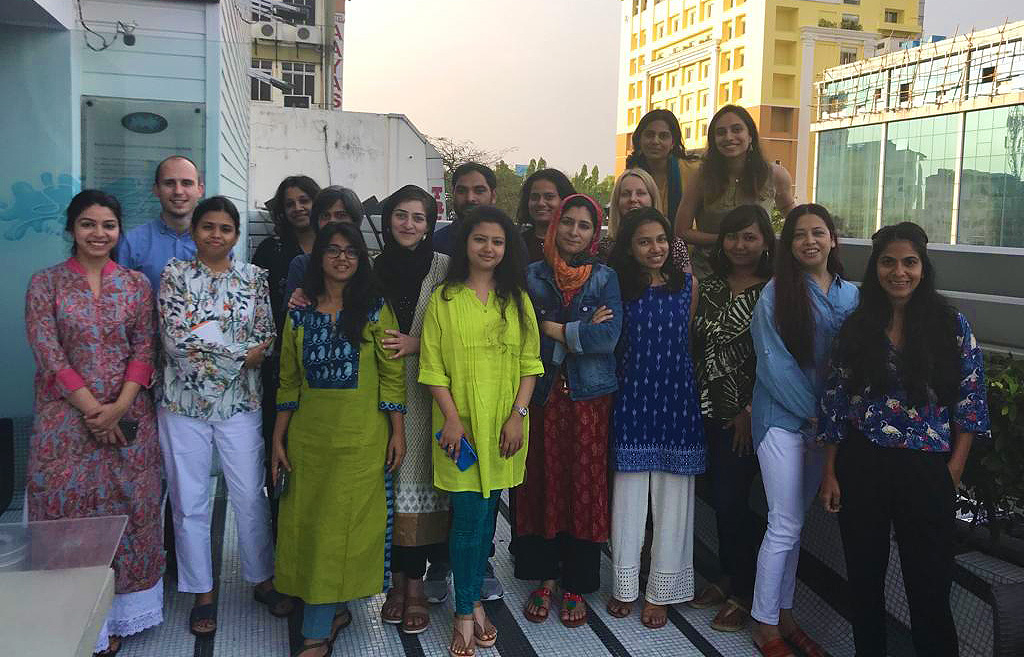
As India strives to crack down on bonded labour and human trafficking, the Thomson Reuters Foundation held a training course for journalists – ‘Reporting on Human Trafficking and Modern Day Slavery’ – in Kolkata from April 1-5. Sponsored by the C&A Foundation, the course attracted 15 journalists from across India for five days of training and debate, and was run by Thomson Reuters Foundation and Reuters sub-editor Rosalind Russell, and our Mumbai correspondent Roli Srivastava.
The cohort included reporters and editors working for The Hindu, The Week, The Delhi Post, Assam Tribune, The Kashmir Monitor, The New Indian Express and Times of India, as well as freelancers. The course featured sessions on staying safe while reporting on modern slavery and interviewing survivors sensitively, untangling myths and misconceptions surrounding the issue, and making sense of and mining data to produce insightful and exclusive stories.
The journalists brainstormed on how to find trafficking angles on major issues such as the Rohingya refugee crisis and India’s upcoming general elections and asked for guidance on how to get their stories picked up by major publications in India and beyond, to achieve maximum impact and raise awareness on the topic.
Several guest speakers joined the course to share their expertise, including Debashish Tandon of the NGO Justice and Care, Subhashri Raptan of Gorabbose Gram Bikas Kendras, and Dr Samarjit Jana – an advocate for sex worker rights. The journalists also had the invaluable opportunity to put into practice what they had learned by interviewing three trafficking survivors – who were familiar and comfortable with speaking to the media.
A highlight of the week was a panel discussion – ‘Reporting Fairly and Sensitively on Human Trafficking in India’ – that saw more than 50 guests attend including local journalists, civil society representatives and government officials. The discussion featured four high-profile speakers: Anindit Chowdhury of the C&A Foundation, Chandreyee Ghose Dutta of The Telegraph, Hasina Kharbhih of the Impulse NGO Network and Matthew Joji of International Justice Mission. In a debate moderated the Thomson Reuters Foundation’s Slavery and Trafficking Editor, Kieran Guilbert, the panellists called for more in-depth and sensitive reporting on the topic as interest rises in India.
The week was rounded off with “Dragon’s Den” session in which all of the journalists pitched a story regarding migration, human trafficking and slavery, with the top seven to receive a mentor over the next few months to help them shape the story for publication.
The Kolkata course was one of a series of courses on covering migration and trafficking and slavery that are being run around the world this year by the Thomson Reuters Foundation in partnership with the C&A Foundation. To find out more about our media development and training programmes, click here.
Share


Sign up to our newsletter
More News
View All
“I had a love-hate relationship with journalists…”
A journalist and a content…
Read More
Working behind the scenes: Reflections from the 5th African Business and Human Rights Forum
A behind-the-scenes view of 5th African Business and Human Rights Forum -…
Read More
World News Day: every $1 invested in journalism can return $100 to society. So why are we letting it collapse?
Defending journalism is not just a moral responsibility. It’s an economic and democratic…
Read More
AI legislation is important in upholding universal human rights
Our Director of Responsible Business,…
Read More
How civil society can counter the rise of legal restrictions across Latin America
New…
Read More
Legal support: a lifeline for civil society and democracy
How democracies become stronger when civil society…
Read More
How upholding workers’ rights builds democratic resilience
How businesses treat their workers…
Read More
Protecting independent media is protecting democracy
How protecting independent media protects democracy itself.
Read More
What legal risks do content creators face? 5 key considerations for influencers
Content…
Read More
What the EU’s Procurement shift could mean for workforce disclosure
In the wake of the…
Read More

