


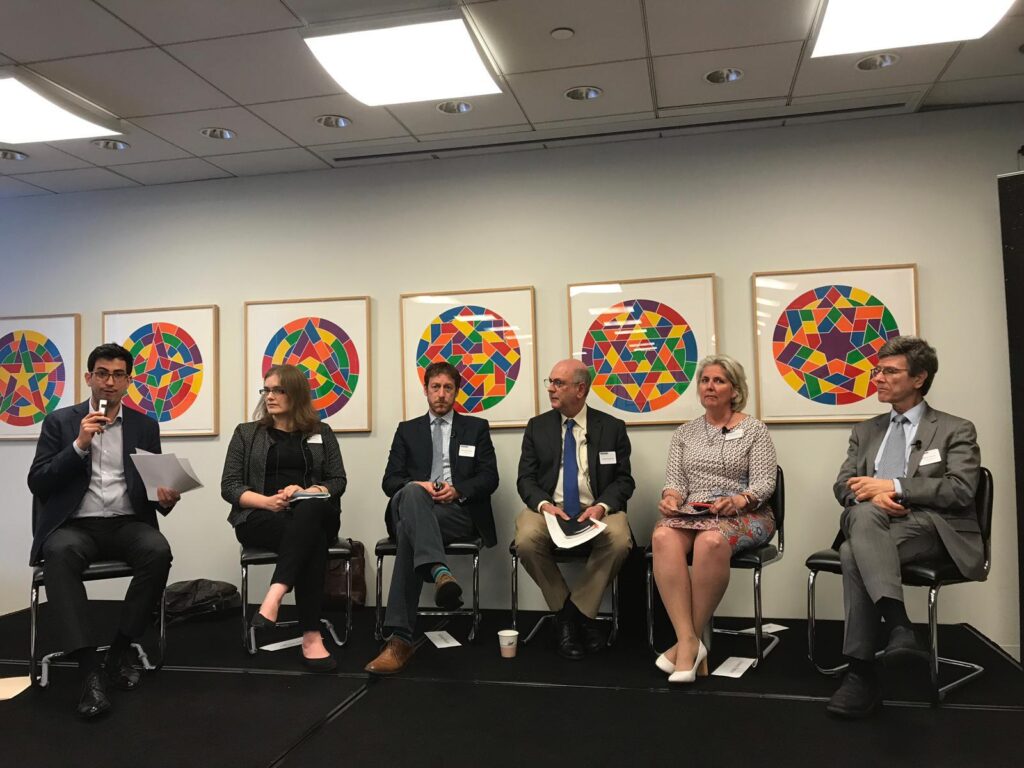
On April 24th, the Thomson Reuters Foundation hosted a panel discussion on a cutting-edge scientific approach to tackling climate change. This first-of-its kind event was hosted at Dentons law firm in New York City and featured leading experts Jeffrey Sachs, Michael Burger, Julie Arrighi, Peter Frumhoff and Lindene Patton. The panel discussion was moderated by the Thomson Reuters Foundation’s Climate Correspondent, Sebastien Malo.
The panel explored event attribution, a ground-breaking new field of study that seeks to determine what proportion of a specific extreme weather event can be blamed on climate change, and by extension to approximate the role of humans and corporations in extreme weather events like hurricanes or droughts. Over seventy legal experts, scientists, academics and corporations gathered to hear the panel’s insights on how this cutting-edge science could hold businesses and other actors accountable for climate change, and also drive a new type of climate-related law suit.
Jeffrey Sachs, world-renowned professor of economics and leader in sustainable development, compared this ground-breaking science to similar legal techniques that have held businesses and governments accountable in the past. Sachs said: “What would litigation do? Ideally it would do something like the litigation over tobacco, and it’s the same issue of attribution… You would sue the ones that are responsible.”
The Thomson Reuters Foundation plays a thought leadership role in the fight to curb climate change, build resilience to it and shift to sustainable energy.
“We thought it was really important for the Thomson Reuters Foundation to host this event and bring science, policy, media and law into the same room. Climate change has always been a focus for the Foundation and we wanted to shine a light on this new legal topic. Bringing such a diverse range of experts into one room was important for us to start the conversation and activate the community to drive action,” said Flavie Fuentes, Manager of TrustLaw in North America.
Moderator Sebastien Malo said: “It’s rare to have the top legal, policy and science minds in the same room to discuss climate change. It was necessary to open the event up to various experts interested in the subject matter. I think we all walked away with a better sense of what the future of law and science may bring.”
To read our climate coverage, visit http://news.trust.org/climate/
Share


Sign up to our newsletter
More News
View All
AI legislation is important in upholding universal human rights
Our Director of Responsible Business,…
Read More
Cómo la sociedad civil puede contrarrestar el aumento de las restricciones legales en América Latina
Una nueva investigación realizada por Thomson Reuters Foundation ha revelado un patrón…
Read MoreHow civil society can counter the rise of legal restrictions across Latin America
New…
Read More
Legal support: a lifeline for civil society and democracy
How democracies become stronger when civil society…
Read More
How upholding workers’ rights builds democratic resilience
How businesses treat their workers…
Read More
Protecting independent media is protecting democracy
How protecting independent media protects democracy itself.
Read More
What legal risks do content creators face? 5 key considerations for influencers
Content…
Read More
What the EU’s Procurement shift could mean for workforce disclosure
In the wake of the…
Read More
Why existing support for civil society can’t solve this crisis
Most support wasn’t designed…
Read More
What happens when content creators and journalists come together?
Our Multimedia Editor for Openly,…
Read More

