


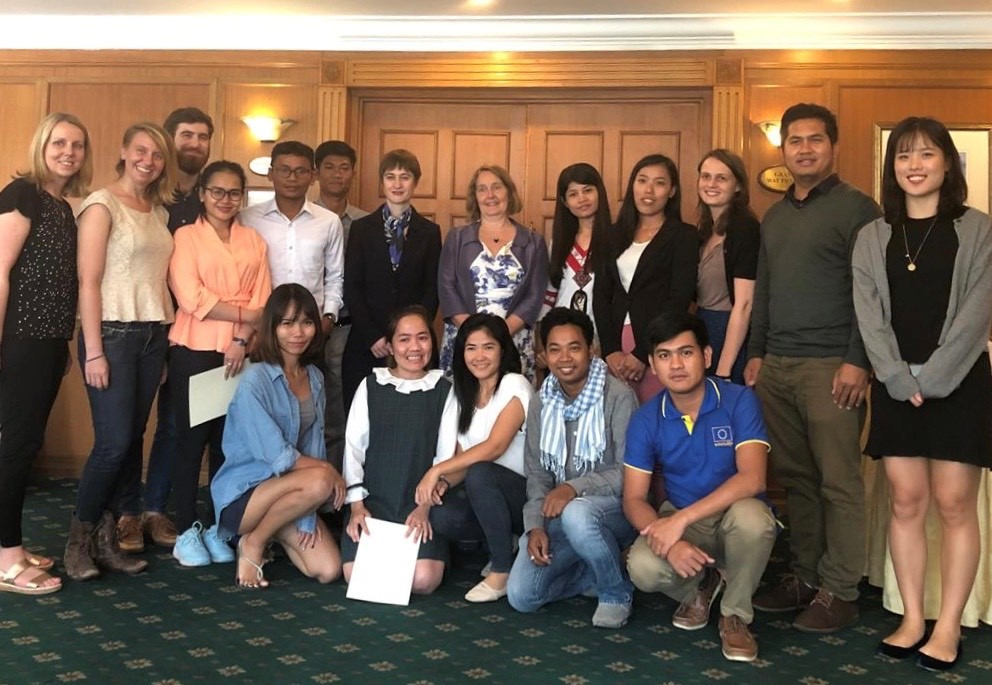
Following last year’s elections in Cambodia and a tightening of the media landscape, the Thomson Reuters Foundation held its first training in the Southeast Asian nation on “Improving Gender Reporting” with a focus on reporting on women and LGBT+ rights. The three-day course from January 30 to February 1 in a Phnom Penh hotel was sponsored by the UK Foreign and Commonwealth Office (FCO) and run by Foundation and Reuters sub-editor Ros Russell and Cambodian journalist Narin Sun.
Twelve Cambodian journalists and four international reporters based in Phnom Penh discussed the practicalities and ethics of reporting on women and the LGBT+ community – subjects which have often been neglected in the Cambodian media. With examples from other countries, the participants learned about the positive impact improving reporting on these issues could have. The mixed male and female group spent time brainstorming ideas to come up with strong pitches for stories from access to abortion to sex education, surrogacy to working conditions in the garment industry and forced marriage to the treatment of transgender entertainment workers. We discussed the challenges to reporting such stories in a fair, accurate and impartial manner and how to overcome them.
We examined laws relating to women’s and LGBT+ rights in Cambodia, including a law prohibiting Cambodian women from marrying foreigners over the age of 50 and the impact of such legislation on individuals. We looked at interview techniques, particularly for vulnerable sources not used to dealing with the media and examined local and global data sources to help journalists better report on gender issues – with a particular focus on the Cambodian Socio-Economic Survey. We discussed ethical dilemmas in a heated afternoon debate and did a lively group exercise on finding the “gender angle” in major national news stories and well as drawing up a code of conduct for LGBT+ reporting.
We spotlighted women and land rights – a hot topic in Cambodia – with the help of guest speaker Sreyleap Song, a land rights campaigner from the Boeung Kak lake activist group. Sreyleap spoke to us about her experiences, in particular the portrayal of women activists in the media, followed by a Q&A session. We also heard from Rachana Chhoeurng from the LGBT+ rights organisation Micro Rainbow International Foundation who told us about the discrimination, prejudice and hardship faced by the LGBT+ community in Cambodia. Together we were able to discuss how the media can work to shed light on these issues in a sensitive way. While few of the journalists had ever tackled these issues before, Rachana’s fascinating and heartbreaking insight left them determined to do more.
The course ended with an address from the FCO’s Asia-Pacific director, Kate White, who highlighted the importance of a free and vibrant press to improve governance and create fair, democratic societies. Finally, each participant was presented with a certificate by the British Ambassador to Cambodia, Tina Redshaw. The participants have been offered further mentoring in English or Khmer to develop their reporting in this important area.
To find out more about our media development and training programmes, click here.
Share


Sign up to our newsletter
More News
View All
World News Day: every $1 invested in journalism can return $100 to society. So why are we letting it collapse?
Defending journalism is not just a moral responsibility. It’s an economic and democratic…
Read More
AI legislation is important in upholding universal human rights
Our Director of Responsible Business,…
Read More
How civil society can counter the rise of legal restrictions across Latin America
New…
Read More
Legal support: a lifeline for civil society and democracy
How democracies become stronger when civil society…
Read More
How upholding workers’ rights builds democratic resilience
How businesses treat their workers…
Read More
Protecting independent media is protecting democracy
How protecting independent media protects democracy itself.
Read More
What legal risks do content creators face? 5 key considerations for influencers
Content…
Read More
What the EU’s Procurement shift could mean for workforce disclosure
In the wake of the…
Read More
Why existing support for civil society can’t solve this crisis
Most support wasn’t designed…
Read More
What happens when content creators and journalists come together?
Our Multimedia Editor for Openly,…
Read More

