


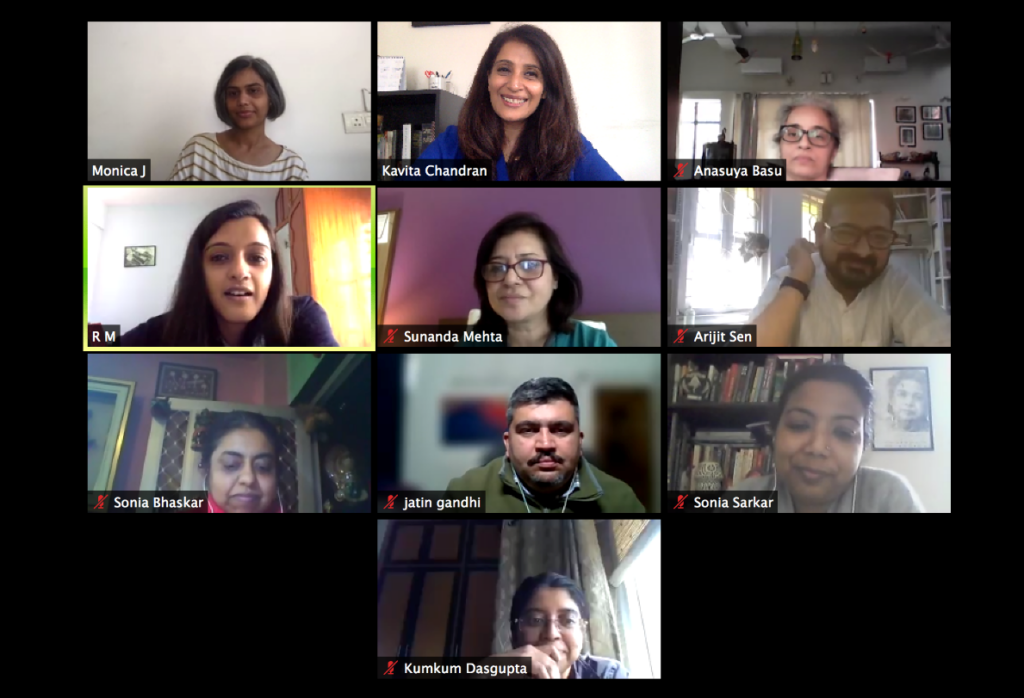
From February 10-12, 2021, the Thomson Reuters Foundation (TRF) held a Training of Trainers (TOT) course for a select group of eight journalists – all recipients of the Chevening Scholarship in some capacity during their career. Participants received a TOT certificate in online learning that certified them to teach a Thomson Reuters Foundation course. Two weeks later, some trainees were chosen to be shadow trainers at a week-long training on Reporting on Human Trafficking for journalists in India, which was taught by the same trainers.
Below is a reflection from one of the participants following their completion of the programme.
By Arijit Sen, Independent Journalist
Wearing a trainer’s hat is not easy to do. I was curious about the course from the start, but also had some uncertainty in my mind. What aspect of my journalism was I supposed to use as a trainer? And what additional skill sets were required? Would the course focus specifically on human trafficking and its different aspects, or would it be a blend of training methods that will highlight reporting on human trafficking?
Thanks to the world-class instructors we had on the course, by the end of three intensive days, I had a much better sense of what a trainer was supposed to do. I also had a better understanding of potential templates and tools that could drive such training – either in newsrooms or for future TRF courses. The course, just like it had promised, did create a wonderful foundation for those setting out to become trainers, as well as enhance the skills of those who already wear that hat!
My primary motivation to join the training was to refocus my work as an independent journalist. Against the backdrop of COVID-19, getting to be part of a group of qualified journalists from different parts of India and to hear from them about stories they have reported on, their motivation and how they have recalibrated their journalism in times of the pandemic, was an essential highlight of the course.
The interactive course introduced us to the basic dimensions of theorization of training, the differences between pedagogy and andragogy and how in reality training can unfold in different situations. Our trainers, Kavita Chandran and Monica Jha, captured it perfectly for us when they presented us with key points: to stick to the theme of the training; to remember every training module should have takeaways and reviews; to remind participants of the objectives; to respectfully evaluate a module; and most importantly, to make the training simple, engaging and fun. A trainer’s detailed notes, we learnt, remain the backbone of any successful training course. Any training course, we were told, must also always be open to inviting subject matter experts.
We were split into small groups and given tasks to perform and present. These were carefully planned exercises that helped us appreciate real-life training situations and also get to know each other better. On the final day, each journalist was asked to present his or her trainer’s notes on a topic related to human trafficking in India. A range of incisive presentations were made – from technology and human trafficking to bonded labour, laws around trafficking, rehabilitation measures, cross-border trafficking and the lives of those affected by trafficking. The feedback received from people with a wealth of knowledge in the subject was crucial.
On the final day, we had an icebreaker session, which involved all eight journalists and two trainers bringing a saree to the online class and share a story around it. It was a beautiful moment.
The three days went by quickly. The creation of such a safe space in which journalists from different backgrounds opened up and discussed their ideas around how training can be conducted was only possible because of the intensive planning that had gone into it.
Arijit Sen is an independent journalist. He was a recipient of a Chevening scholarship that helped him pursue his Masters in Human Rights Law at SOAS, University of London.
Share


Sign up to our newsletter
More News
View All
World News Day: every $1 invested in journalism can return $100 to society. So why are we letting it collapse?
Defending journalism is not just a moral responsibility. It’s an economic and democratic…
Read More
AI legislation is important in upholding universal human rights
Our Director of Responsible Business,…
Read More
How civil society can counter the rise of legal restrictions across Latin America
New…
Read More
Legal support: a lifeline for civil society and democracy
How democracies become stronger when civil society…
Read More
How upholding workers’ rights builds democratic resilience
How businesses treat their workers…
Read More
Protecting independent media is protecting democracy
How protecting independent media protects democracy itself.
Read More
What legal risks do content creators face? 5 key considerations for influencers
Content…
Read More
What the EU’s Procurement shift could mean for workforce disclosure
In the wake of the…
Read More
Why existing support for civil society can’t solve this crisis
Most support wasn’t designed…
Read More
What happens when content creators and journalists come together?
Our Multimedia Editor for Openly,…
Read More

