CTP

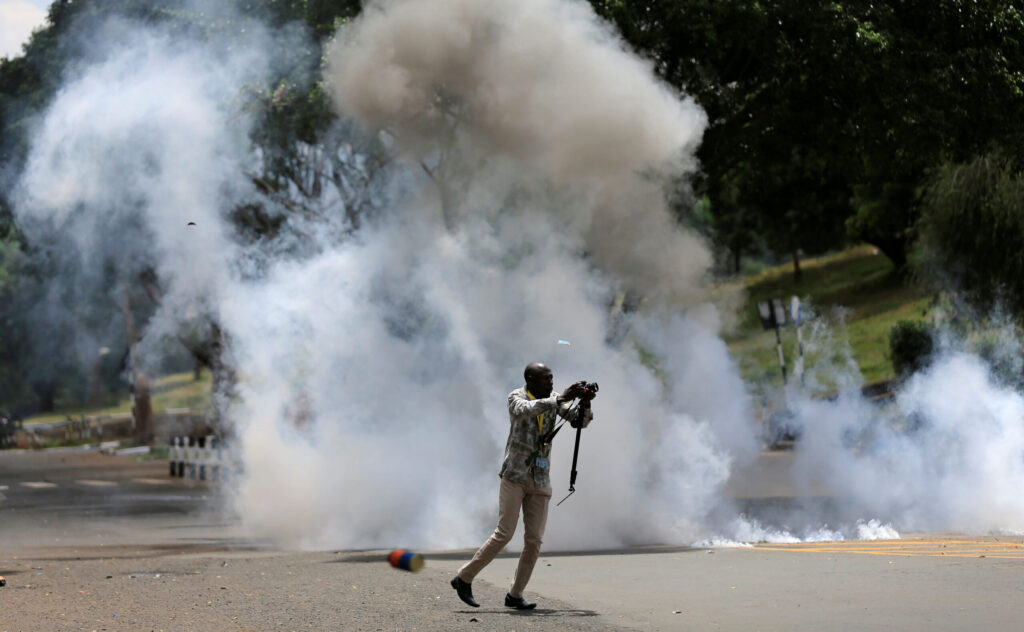
Since 2015, the Committee to Protect Journalists in India observed more arrests and cases lodged against journalists under various legislations. Some of these include the Indian Penal Code 1860, Information Technology Act 2000 and The Unlawful Activities (Prevention) Act, 1967. This marked the beginning of a new and dangerous era. There are also several cases that were lodged against journalists while they are reporting during the COVID-19 pandemic under the Epidemic Diseases Act, 1897.

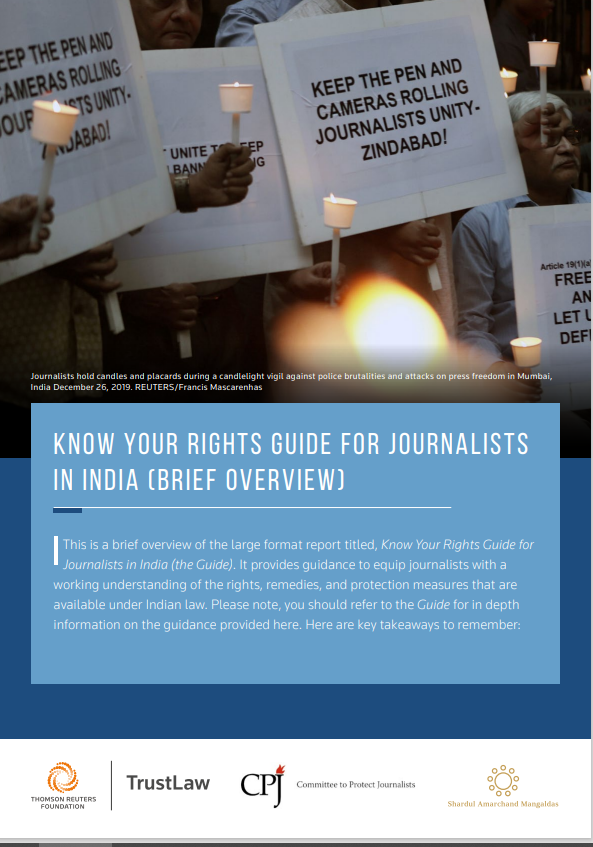
The brief overview to the guide is intended to provide a concise, user-friendly, practical guidance for journalists and newsrooms seeking to understand their rights in India. It will be useful resource for journalists as it summarises their rights while reporting, given their role is an essential service and they support the important pillar of freedom of speech. It also highlights the offences they should be mindful of that can be used for arrest. This was produced by the Committee to Protect Journalists and the Thomson Reuters Foundation, with pro bono legal research provided by Shardul Amarchand Mangaldas & Co. .

Details

Countries

India

Download Guide

Download pdf: Download Guide

Tags

CTP

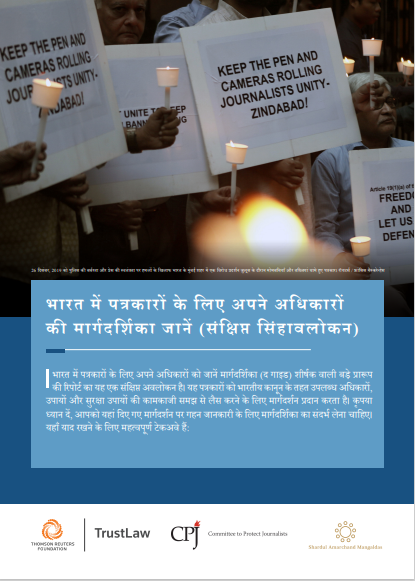
This is the Hindi version of the brief overview to the Know Your Rights Guide for journalists in India. It is intended to provide user-friendly, practical guidance for journalists and newsrooms seeking to understand their rights and protections in India. The guide and the brief overview are available in English, and Hindi.

Details

Countries

India

Languages

Hindi

Download Guide

Download pdf: Download Guide

CTP

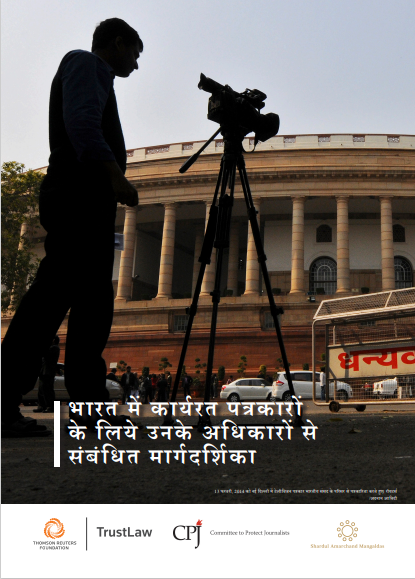
This is the Hindi version of the guide and is intended to provide user-friendly, practical guidance for journalists and newsrooms seeking to understand their rights and protections in India. This guide is also available in English. A brief overview of the guide is also available in English and Hindi.

Details

Countries

India

Languages

Hindi

Download Guide

Download pdf: Download Guide

CTP

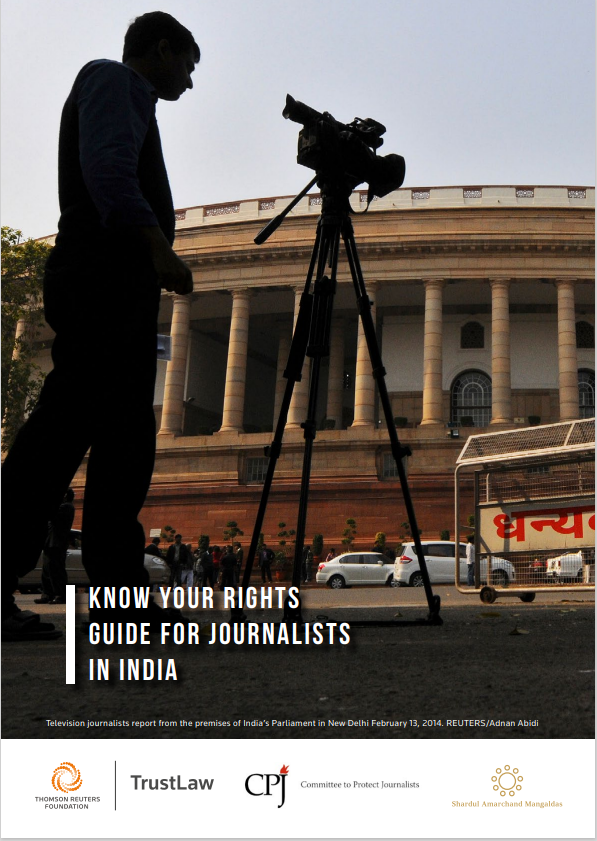
This guide is intended to provide user-friendly, practical guidance for journalists and newsrooms seeking to understand their rights and protections in India.

Details

Countries

India

Languages

English

Download Guide

Download pdf: Download Guide

TCT

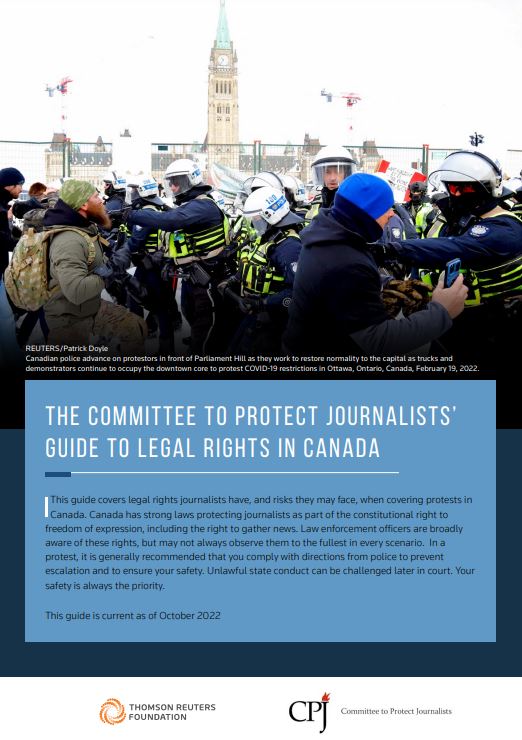
This guide describes in simple language the legal rights journalists have, and risks they may face, when covering protests in Canada. The guide is both in English and French.

Details

Countries

Canada

Languages

English

Download Guide

Download pdf: Download Guide

TRF

The Thomson Reuters Foundation – in collaboration with UNESCO, the International Women’s Media Foundation (IWMF) and the International News Safety Institute (INSI) – has developed a suite of resources for journalists, media managers and newsrooms to strengthen responses to online and offline abuse. 

Details

Countries

NA

Languages

English

Download Guide

Download pdf: Download Guide

TRF

The Thomson Reuters Foundation’s global pro bono service, TrustLaw, invites law firms and lawyers around the world to share information about their firm’s pro bono programme for inclusion in the 2024 TrustLaw Index of Pro Bono.


The TrustLaw Index of Pro Bono identifies global trends in the pro bono marketplace, highlights success factors in pro bono practices and looks at the amount of pro bono work law firms are undertaking on a country-by-country basis.
Since the launch of the TrustLaw Index of Pro Bono in 2014, it has rapidly become a central repository of information on the global pro bono sector, uncovering emerging trends and quantifying the complex ways in which the sector is evolving. The information provided as part of the TrustLaw Index is an invaluable tool to help spread the practice of pro bono around the world.


As pro bono practices vary across the globe, the Index seeks to gather data on a jurisdiction-by-jurisdiction basis where similar data is compared and tracked in local markets. In conducting research for the development of the TrustLaw Index of Pro Bono, the feedback received from lawyers in “emerging” pro bono markets is that this data is invaluable for them in assessing their own firm’s practice and advocating to expand their pro bono programmes.
See the 2022 Index findings for additional information on how the data is presented.

Details

Countries

NA

Languages

English

Download Guide

Download pdf: Download Guide

TRF

This comparative study covers the legal framework and case law of government advertising in Mexico, Argentina, Guatemala, Honduras, Peru and Uruguay as well as the international standards applicable to this topic.

Details

Countries

ArgentinaGuatemalaHondurasMexicoPeru

Languages

Spanish

Download Report

Download pdf: Download Report

Tags

ENT

This report examines laws relating to online sexual exploitation and abuse (OSEA) in international law and standards, in regional law and standards with a focus on Europe, and in five focus countries: Kenya, Nigeria, India, the United States and the United Kingdom. We also highlight gaps and loopholes.

As conducted, the research examined the following issues: Definitions of the term OSEA; Laws addressing jurisdiction around OSEA crimes and cooperation among states; Laws concerning the right to freedom of expression or speech online and its relationship with OSEA; Laws concerning the right to privacy online and its relationship with OSEA; and laws concerning the regulation of digital service providers and platforms.

The report also features expert testimony and utilizes a survivor centric approach to illustrate the impact of OSEA and highlight the challenges faced in keeping people safe in a rapidly changing digital landscape.

The full report is a publication by Equality Now, with design and publication support from the Thomson Reuters Foundation and Practical Law (Thomson Reuters).

Details

Countries

IndiaKenyaNigeriaUnited KingdomUnited States

Download Report

Download pdf: Download Report

Tags

SSF

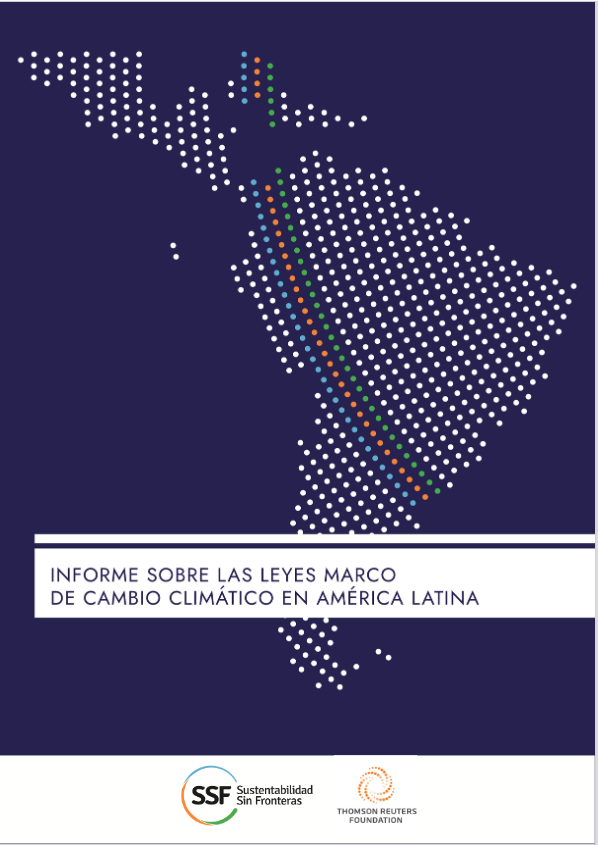
This report covers and compares climate change laws in Argentina, Brazil, Chile, Colombia, Mexico, Paraguay and Peru based on twelve factors, including adaptation and mitigation plans, financial mechanisms, regulation on just transition and climate justice, and short- and long-term commitments.

Details

Countries

ArgentinaBrazilChileColombiaMexicoParaguay

Languages

Spanish

Download Report

Download pdf: Download Report

Tags