



Recognising businesses that have set a gold standard in efforts to eradicate forced labour from their supply chains, the Thomson Reuters Foundation today announced the seven companies shortlisted for the Enterprise categories of its Stop Slavery Award.
Launched in 2015, the Award celebrates both Goods and Service companies and SMEs who can be considered “best in class” based on the policies they have in place to limit the risk of forced labour in their supply chain and operations. This year, the Thomson Reuters Foundation launched six additional categories to honour the range of different actors – including NGOs, grassroots organisations and journalists – also leading the fight against modern slavery.
Global brands representing a range of industries – from fashion to food, drink and technology – applied to this year’s two Enterprise categories. The winning companies will be announced at a special Award ceremony, to be hosted at the offices of Baker McKenzie in London on the evening of Thursday, 20th February. Winners will be presented with a print created especially for the initiative by Turner Prize-winning artist Anish Kapoor.
The Judging Panel is comprised of leading figures and experts in the anti-slavery space: Human Rights Watch Executive Director Kenneth Roth; Nobel Peace Prize Laureate Kailash Satyarthi; Former UK Independent Anti-Slavery Commissioner Kevin Hyland; International Criminal Lawyer Patricia Viseur Sellers; New York County District Attorney Cyrus R. Vance, Jr.; Advisor to the B Team and Visiting Executive at Oxford’s Saïd Business School Rajiv Joshi; and Thomson Reuters Foundation COO Nick Glicher.
“As a global company, IBM pursues the highest standards of corporate responsibility in all we do – supporting and empowering employees, working with clients and suppliers, and governing our company. This includes ensuring that slavery and human trafficking are not taking place in any of our supply chains or in any part of our business globally,” said Guillermo Miranda, Vice President and Global Head of IBM Corporate Social Responsibility.
James Bartle, Outland Denim Founding CEO added: “To be shortlisted for this award holds particular significance for us, it represents exactly why Outland Denim was created. This award is a testament to the huge power small and medium-size businesses can have in eradicating forced labour and contributing to positive social change in vulnerable communities, while inspiring others in their field to do the same.”
The shortlist for the Stop Slavery Enterprise Award – Goods & Service Companies:
The shortlist for the Stop Slavery Enterprise Award – Small & Medium-Sized Companies:
The selection process:
All applicants completed an extensive questionnaire developed in partnership with global law firm Baker McKenzie and experts in the field. It highlights best practice in corporate commitment and reporting, performance management, business partner engagement, risk assessment and investigation and remediation.
Submissions to the Award were assessed by an independent third party, Uplift Worldwide, using specific criteria based on existing standards and best practices to score the applicants.
Uplift Worldwide developed a decision matrix to assess the submissions and compared company responses to assessment criteria that identified a company’s practice as leading, base compliant, or lagging on a scale of 1-10 with individual weighting per question. The assessment criteria were developed using a combination of existing standards (e.g. UK Modern Slavery Act, US Federal Acquisition Requirements) and best practices (e.g. 2016 Know the Chain Benchmarking Methodology, 2016 Business Authentication Criteria).
Our work in the fight against modern slavery and human trafficking is part of our larger focus on inclusive economies.
Share


Sign up to our newsletter
More News
View All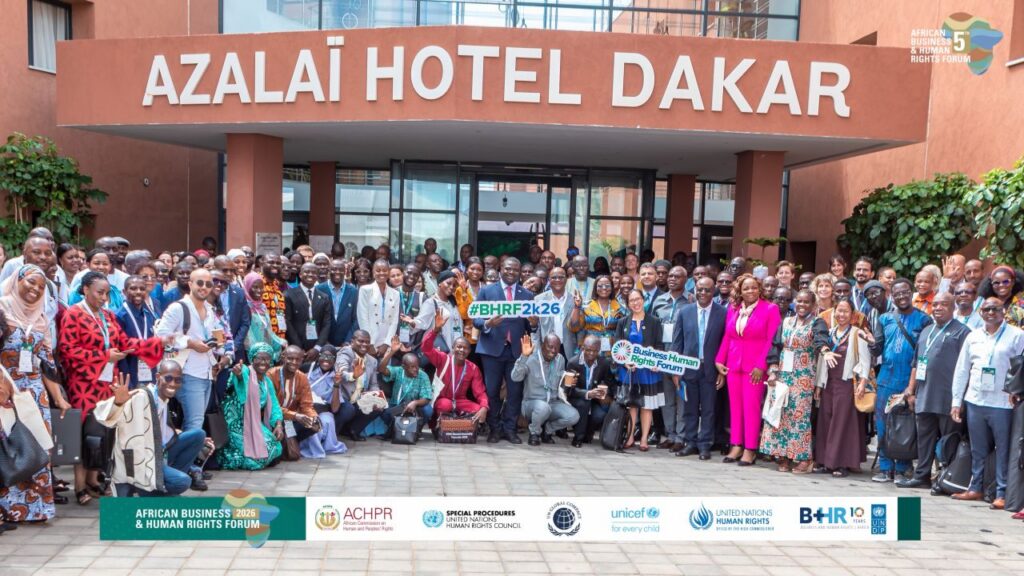
Working behind the scenes: Reflections from the 5th African Business and Human Rights Forum
A behind-the-scenes view of 5th African Business and Human Rights Forum -…
Read More
World News Day: every $1 invested in journalism can return $100 to society. So why are we letting it collapse?
Defending journalism is not just a moral responsibility. It’s an economic and democratic…
Read More
AI legislation is important in upholding universal human rights
Our Director of Responsible Business,…
Read More
How civil society can counter the rise of legal restrictions across Latin America
New…
Read More
Legal support: a lifeline for civil society and democracy
How democracies become stronger when civil society…
Read More
How upholding workers’ rights builds democratic resilience
How businesses treat their workers…
Read More
Protecting independent media is protecting democracy
How protecting independent media protects democracy itself.
Read More
What legal risks do content creators face? 5 key considerations for influencers
Content…
Read More
What the EU’s Procurement shift could mean for workforce disclosure
In the wake of the…
Read More
Why existing support for civil society can’t solve this crisis
Most support wasn’t designed…
Read More

